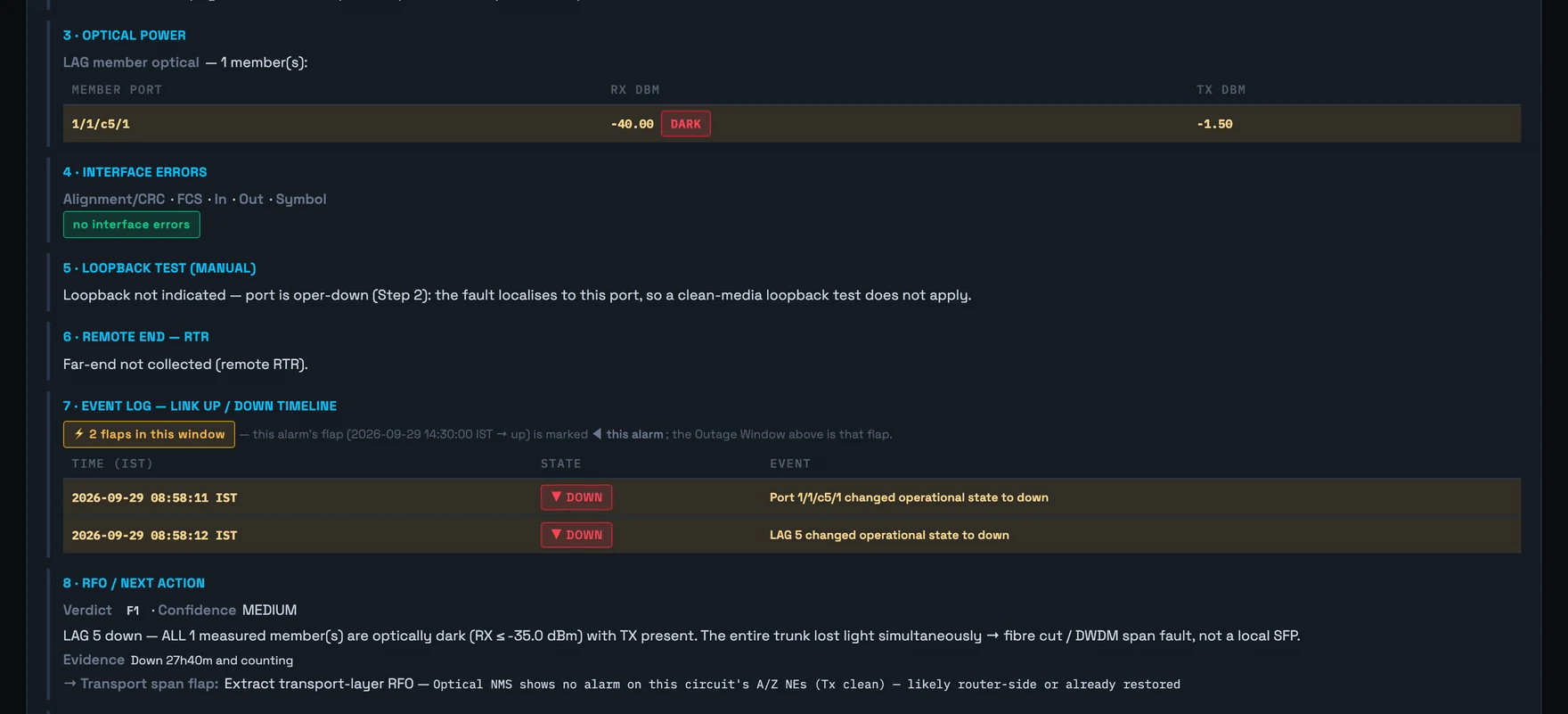
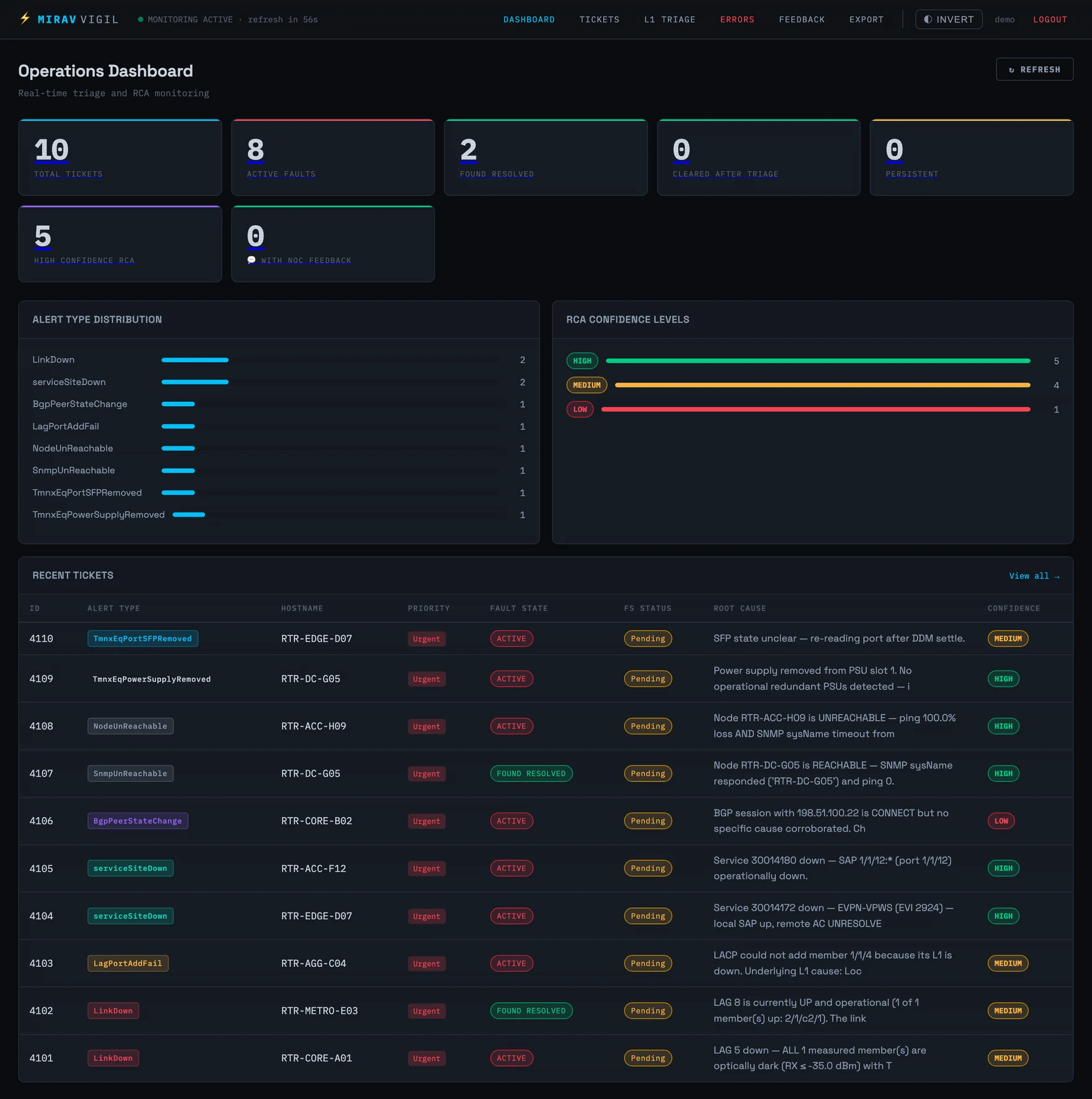
Mirav Vigil watches your fault queue, logs into the affected router read-only, pulls the evidence an L1 engineer would have pulled by hand, and writes a root-cause verdict with a confidence grade, the supporting CLI output, and the L2 queue it should go to — typically in well under a minute.
Figures measured on the deployed system across 188 routers and 9 alarm types. Customer name withheld.
A LinkDown fires. An engineer opens a jump-host session, SSHes to the router, reads the LAG, reads per-member optical power, reads the event log, checks the peer, cross-checks the optical NMS and the circuit inventory — then writes three lines into the ticket and escalates. Twenty minutes of keystrokes that are identical every single time.
And roughly half the time, the fault had already cleared before anyone looked.
Vigil runs the L1 playbook the moment the ticket appears — not when someone gets to it.
Polls the ITSM fault queue, parses the alarm subject into a structured fault, and suppresses duplicates and storms.
Jump-host SSH to the router. Up to 70 read-only commands, chosen by alarm type, scoped to the alarm window — plus SNMP and ping from the NMS vantage.
Parses CLI into typed objects and cross-checks against optical NMS, circuit inventory and backbone topology. Flags OSS-vs-device mismatches.
Root cause, confidence grade, per-layer OK/WARN/CRIT breakdown, what evidence was missing, and the L2 queue to dispatch to.
Re-probes on backoff, records the outage window down→up, promotes chronic flappers, and flags when a ticket is safe to close.
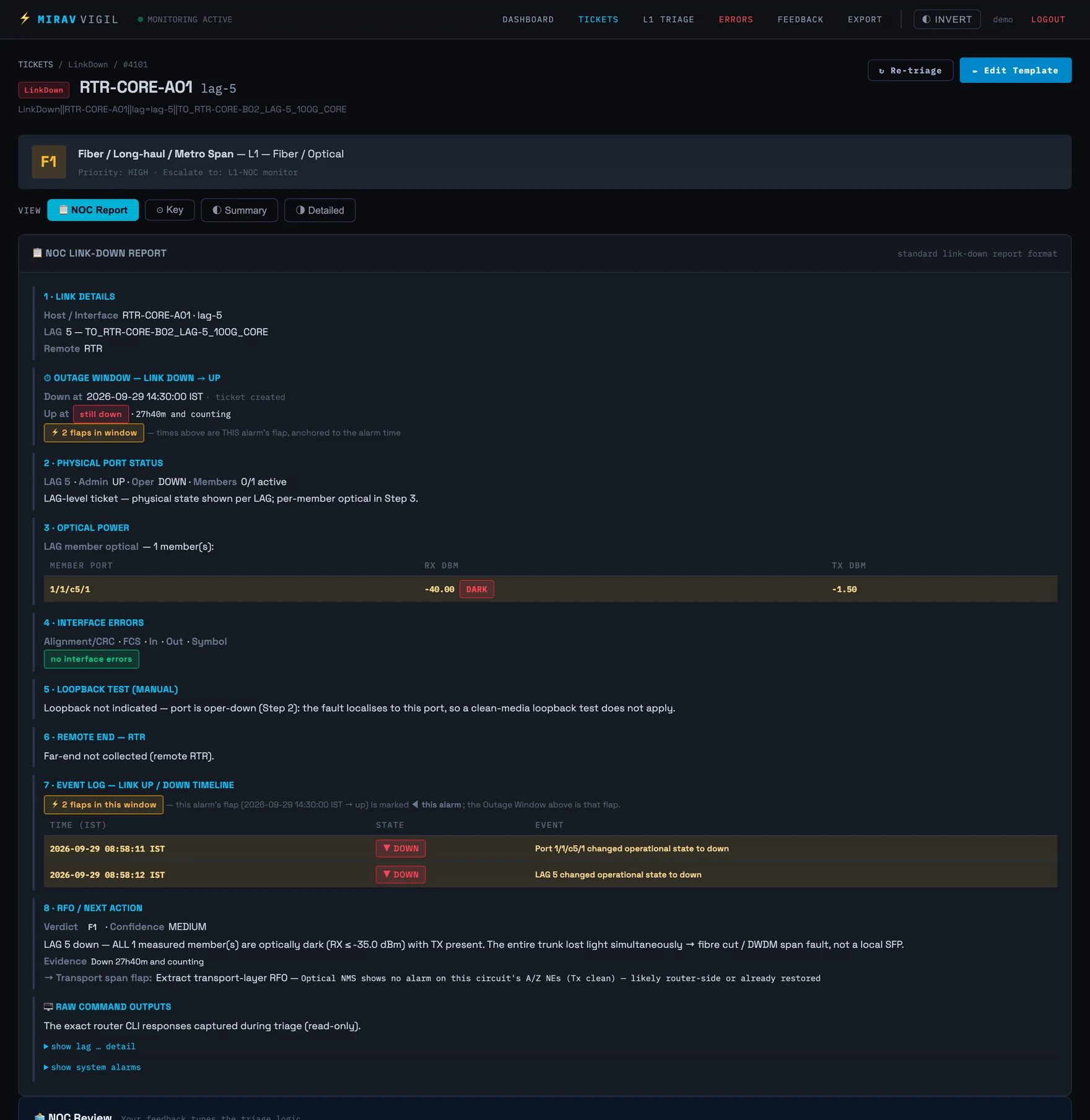
Vigil never asserts a root cause it can't point at. Every verdict names the reading that drove it, and every reading names the command that produced it. When the evidence is thin, it says so and grades itself LOW rather than guessing.
The fastest way to lose a production network is an agent that can type. Vigil cannot.
Every command is prefix-matched against an explicit read-only allow-list before it reaches the transport. Anything not on the list is refused — including anything a model might invent.
Vigil reaches devices the way your engineers do: through your existing jump host, with your existing credentials and ACLs. No new inbound path to the network.
Vigil marks a fault recovered in its own state and recommends closure. Writing to the ticket system stays a human decision — by design, and blocked at the integration layer.
A single small VM in your own environment. Device evidence and ticket data never leave your perimeter.
Every command issued, every byte returned, every verdict and every engineer correction is stored and queryable.
Vigil produces a recommendation. Dispatch, remediation and closure remain your team's call — with better information in front of them.
These nine account for the overwhelming majority of L1 fault volume on an IP/MPLS backbone. Each has a purpose-built analyser — not a generic prompt.
| Alarm family | What Vigil decides | Share of volume |
|---|---|---|
| LinkDown · LAG port add-fail | Fibre/DWDM span cut vs near-end SFP or patch vs admin-down vs chronic flap — using per-member optical power on both ends. | 30% |
| BGP peer state change | Normal churn vs peer-local fault vs an underlay link failure that removed the route to the peer. | 25% |
| SNMP / node unreachable | Genuinely down vs reachable-and-false-alarm — probed from the NMS vantage, not from the agent. | 25% |
| Service site down Epipe · VPLS · EVPN-VPWS | Local access-circuit fault vs transport/LSP vs a remote PE that stopped advertising the EVI. | 16% |
| Hardware removal SFP · card · PSU | Confirms the removal against device and system alarms, and flags lost redundancy as a risk. | 4% |
Volume shares from 1,753 tickets ingested in the live deployment. Transport, command sets, parsers and diagnostic logic are separate layers, so the platform is vendor-pluggable by design.
Live queue, verdict and confidence per ticket, what's already recovered, and where the agent was unsure — so the shift spends its attention on the faults that need a person.
Vigil doesn't replace your NOC. It removes the part of the job that was never judgement in the first place — and hands your engineers a fully evidenced starting point instead of a blank ticket.
Read-only means the pilot is genuinely low-risk: worst case, Vigil is wrong in a report nobody acted on.
One VM inside your network. Read-only credentials on your existing jump host. Read access to the fault queue.
Vigil triages live tickets in parallel with your L1 shift. Nothing is written anywhere. You compare.
Your engineers accept or reject each verdict. Thresholds, evidence sets and dispatch routing are tuned to your network.
The shift starts working from Vigil's report instead of a raw alarm. You decide what, if anything, it is allowed to act on.
No. The diagnostic logic is deterministic code — per-alarm-type analysers with explicit thresholds, scoring and evidence rules. The same inputs always produce the same verdict, and you can read exactly why. Language models are used where language is the problem, not to decide whether your fibre is cut.
Nothing breaks — because it can only write into its own report. Wrong verdicts are visible, graded by confidence, and correctable: engineers reject or amend them from the ticket view, and those corrections feed back into tuning. We would rather ship a verdict marked LOW than a confident guess.
No. Vigil runs on a VM inside your environment. Device output, ticket content and credentials stay within your perimeter.
Vigil is layered so that the transport, the command sets, the parsers and the diagnostic logic are independent of each other — a new platform is a command-set and parser exercise against the same engine, not a rebuild. The current production deployment runs on Nokia SR OS. Tell us your mix and we'll scope it with you.
Your NMS tells you a port went down. Vigil logs into that port, reads the optical power on every LAG member, reads the peer, reads the event log around the alarm, checks the circuit in inventory, and tells you whether it is a fibre cut, a dirty patch, a flap that already cleared, or a remote PE problem — and who should get it. It is the step after correlation, not a replacement for it.
One VM, read-only credentials on an existing jump host, read access to the fault queue, and about an hour a week of an L1 engineer's time to mark verdicts right or wrong. That's the whole ask.
We'll show you, on your own alarm types, exactly what Vigil would have written into each ticket — and how much of that queue never needed a human at all.
Mirav Labs · Delhi, India · +91-9650210909